
June 1, 2026
Introduction
Climate change remains one of the greatest environmental challenges facing the world today. Rising temperatures, desertification, flooding, coastal erosion, and declining agricultural productivity continue to threaten livelihoods, ecosystems, and economic development.
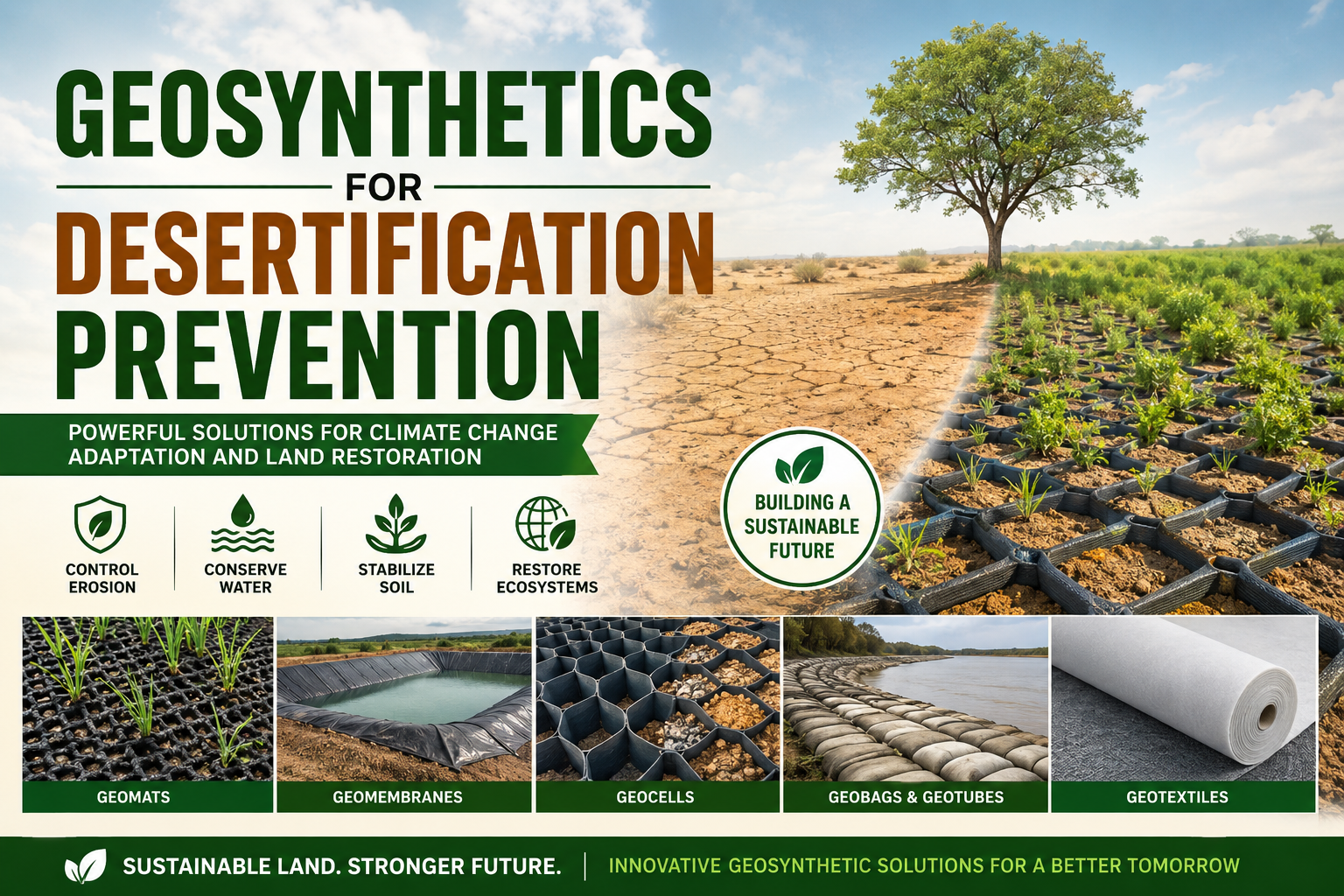
While governments and environmental organizations pursue various climate adaptation strategies, the use of geosynthetics for desertification prevention has emerged as an effective engineering solution. Geosynthetics help stabilize soil, conserve water resources, control erosion, and create favorable conditions for vegetation growth.
In Nigeria and other semi-arid regions, these innovative materials can play a vital role in mitigating some of the adverse effects of climate change.
What Are Geosynthetics?
Geosynthetics are polymer-based materials used in civil engineering and environmental projects to improve soil performance and address challenges such as erosion, instability, drainage, and low load-bearing capacity.
Common geosynthetic products include:
- Woven geotextiles
- Nonwoven geotextiles
- HDPE geomembranes
- HDPE geocells
- Geomats
- Geogrids
- Geodrains
Depending on their application, geosynthetics may be permeable or impermeable and can significantly enhance the durability and effectiveness of environmental protection projects.
The Relationship Between Climate Change and Desertification
Climate change contributes directly to desertification through prolonged droughts, reduced rainfall, rising temperatures, and the loss of vegetation cover.
As vegetation disappears, soils become vulnerable to:
- Wind erosion
- Water erosion
- Reduced moisture retention
- Loss of fertility
- Reduced agricultural productivity
Consequently, communities experience food insecurity, environmental degradation, and declining economic opportunities.
Fortunately, geosynthetics provide practical solutions that help restore degraded lands and improve environmental resilience.
Using Geomats to Control Wind Erosion and Promote Vegetation
One of the most effective geosynthetic products for desertification prevention is the hybrid geomat.
A geomat typically consists of interwoven HDPE strands bonded to a geotextile layer. When installed on sandy or erosion-prone surfaces, the geotextile underlay prevents soil displacement while the geomat traps soil particles and organic matter.
Benefits of Geomats for Desertification Control
- Reduce wind erosion
- Stabilize loose sandy soils
- Encourage vegetation establishment
- Protect exposed slopes
- Improve ecosystem restoration efforts
Furthermore, geomats can stabilize migrating sand dunes in severe desert environments, reducing the spread of desertification into agricultural lands and communities.
HDPE Geocells for Soil Stabilization
HDPE geocells provide another effective solution for combating desertification.
These three-dimensional cellular confinement systems are filled with in-situ soil and installed over a geotextile underlay. The resulting structure improves soil stability and protects the surface from wind erosion.
Advantages of HDPE Geocells
- Increase soil confinement
- Improve soil stability
- Minimize soil displacement
- Support vegetation growth
- Reduce maintenance requirements
As a result, geocells create sustainable landscapes that can withstand harsh environmental conditions.
Rainwater Harvesting with HDPE Geomembranes
Water scarcity remains one of the major drivers of desertification. Therefore, conserving available water resources is essential.
HDPE geomembranes provide an impermeable barrier that allows communities to harvest and store rainwater efficiently.
When installed with a geotextile underlay, geomembranes prevent seepage losses and maximize water retention in reservoirs.
Applications of HDPE Geomembranes
- Rainwater harvesting ponds
- Irrigation reservoirs
- Agricultural water storage
- Livestock watering systems
- Ecosystem restoration projects
By ensuring reliable water availability, geomembranes support vegetation growth and climate adaptation efforts.
Preventing Coastal and Riverbank Erosion with Geotextiles
Climate change has increased the frequency and severity of flooding events across many regions of Nigeria.
Consequently, coastal and riverbank erosion continues to threaten infrastructure, agricultural land, and human settlements.
Engineers often deploy:
- Geotextiles
- Geobags
- Geotubes
- Gabions
- Reno mattresses
to stabilize vulnerable shorelines and riverbanks.
A properly selected geotextile acts as a filtration and separation layer, while geobags and geotubes provide the weight and reinforcement required to resist water forces.
This combination effectively reduces soil loss and protects valuable land resources.
Why Material Quality Matters
The success of any geosynthetic project depends heavily on material quality and proper engineering design.
For example, geotextiles, geomembranes, geomats, and geocells must possess:
- Adequate tensile strength
- High puncture resistance
- Suitable hydraulic properties
- Long-term durability
- UV resistance of at least 70% where exposure conditions require it
Poor-quality materials often lead to premature failures, increased maintenance costs, and reduced project performance.
Therefore, selecting high-quality geosynthetics remains critical for long-term success.
Related Reading
To learn more about erosion control and environmental protection using geosynthetics, read our article on The Danger of Erecting a Gabion Structure Without Geotextile.
You may also find our guide on Soil Consolidation Using Geotextiles – Strengthening Foundations for a Safer Future helpful for understanding how geotextiles improve soil stability.
For international information on geosynthetics and environmental engineering, visit the International Geosynthetics Society (IGS).
Partner with Gabions Geomembrane & Geotextile Ltd
Gabions Geomembrane & Geotextile Limited is a leading supplier of high-quality geosynthetics in Nigeria and West Africa.
Our product range includes:
- Woven and nonwoven PET and PP geotextiles
- HDPE geomembranes (0.5 mm, 1 mm, and 2 mm)
- Geogrids
- Geomats
- Geocells
- Erosion control blankets
- Geodrains
- Gabions
- Reno mattress systems
We provide free technical advice, professional design support, and premium-quality materials at competitive prices.
Contact Us
Gabions Geomembrane & Geotextile Limited
Kaduna, Nigeria
Phone:
+234 8185 285 346
+234 7037 845 174
+234 8020 657 472