
August 31, 2026
Climate change is creating serious environmental challenges across many parts of the world. Rising temperatures, flooding, soil erosion, desertification and the loss of arable land can threaten agriculture, infrastructure and livelihoods.
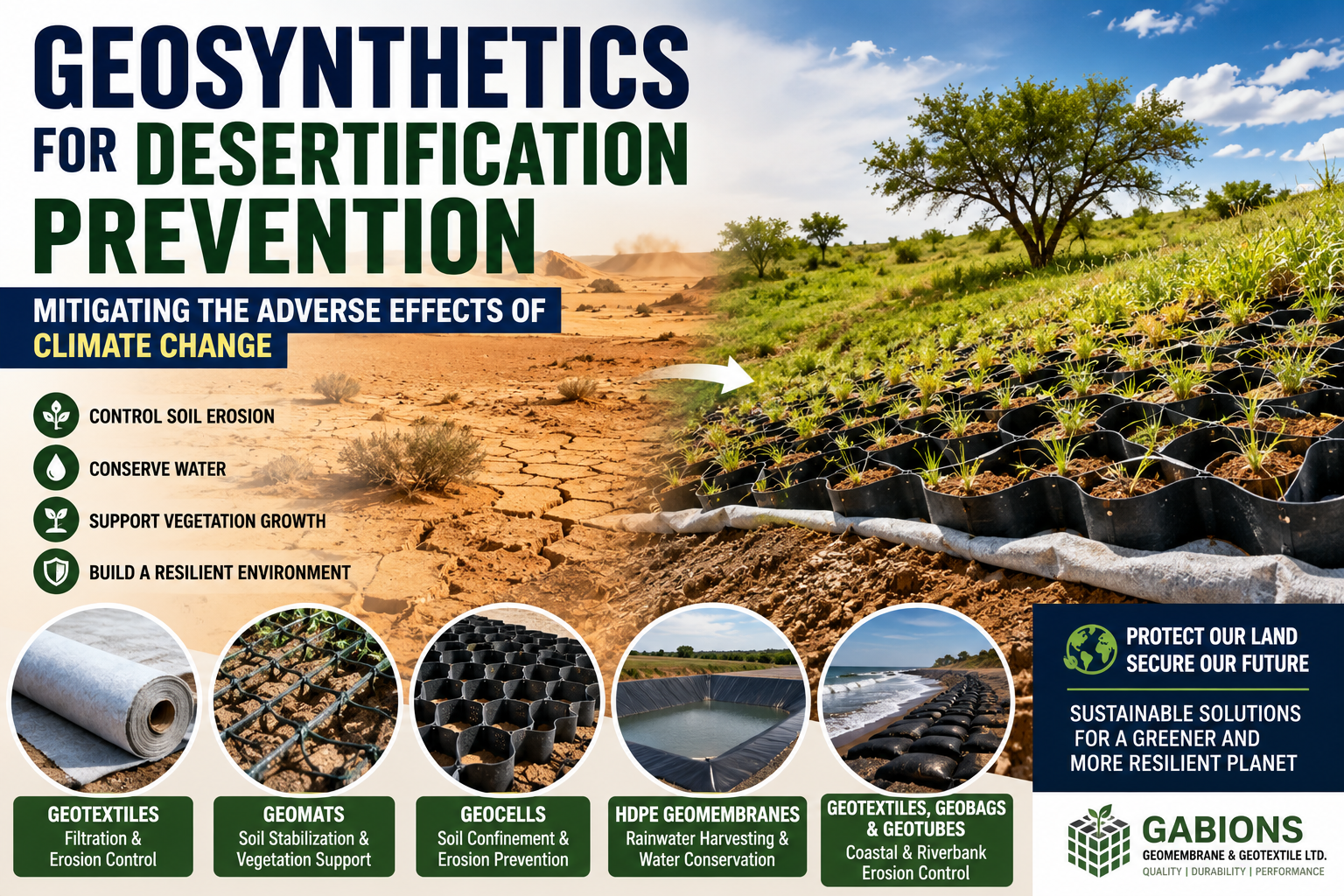
One practical engineering approach to address some of these challenges is the use of geosynthetics for desertification prevention. These materials can help control soil erosion, stabilize vulnerable land, conserve water and create better conditions for vegetation establishment.
In Nigeria, where erosion, land degradation and water scarcity affect different regions, appropriately designed geosynthetic systems can support environmental protection and climate-change adaptation.
What Are Geosynthetics?
Geosynthetics are polymeric materials manufactured for use in civil engineering, environmental and geotechnical applications. They help address problems involving soil erosion, instability, drainage, reinforcement and water containment.
Common types of geosynthetics include:
- Woven geotextiles
- Nonwoven geotextiles
- HDPE geomembranes
- HDPE geocells
- Geomats
- Geogrids
- Geodrains
- Erosion control blankets
The International Geosynthetics Society identifies functions such as separation, filtration, drainage, barrier, surface erosion control, reinforcement, stabilization and protection among the major functions of geosynthetics.
Therefore, the right product should always depend on the specific site conditions and engineering requirements.
How Does Climate Change Contribute to Desertification?
Climate change can intensify environmental conditions that contribute to land degradation. Prolonged dry periods, changing rainfall patterns, high temperatures and loss of vegetation can leave soil increasingly exposed to wind and water erosion.
Once vegetation disappears, exposed soil becomes more vulnerable. Consequently, wind can transport loose soil particles, while rainfall and surface runoff can wash away fertile topsoil.
This creates a cycle of:
Vegetation loss → exposed soil → erosion → soil degradation → reduced vegetation growth.
Breaking this cycle requires appropriate land-management practices alongside suitable engineering solutions.
Using Geomats to Prevent Soil Erosion
A hybrid geomat can help stabilize exposed soil and create conditions that support vegetation establishment.
A typical system combines interwoven HDPE strands with a geotextile layer. The geotextile can help retain soil particles, while the three-dimensional geomat structure provides surface protection.
How Geomats Help
A properly designed geomat system can:
- Reduce wind-induced soil movement
- Control surface erosion
- Stabilize exposed sandy soil
- Support vegetation establishment
- Protect vulnerable slopes
- Help stabilize sand dunes in severe conditions
Furthermore, the spaces within the geomat can trap soil particles and create a more stable surface for vegetation.
This approach is particularly relevant where sandy soils remain exposed and rainfall is limited but sufficient to support drought-resistant vegetation.
Research and technical literature on geosynthetic erosion control also recognize geotextiles, geocells and other erosion-control products as tools for reducing erosion and supporting vegetation establishment.
HDPE Geocells for Desertification Control
HDPE geocells provide another method for stabilizing vulnerable soils.
Geocells consist of three-dimensional cellular structures that confine soil or other suitable fill materials. When installed over a properly selected geotextile underlay, the system can create a more stable surface.
Benefits of HDPE Geocells
Geocells can help:
- Confine soil within individual cells
- Reduce surface soil movement
- Improve surface stability
- Protect vulnerable areas from erosion
- Create a stable medium for vegetation
Consequently, geocells can provide an alternative to geomats in some soil-stabilization and erosion-control applications.
However, engineers should select the appropriate geosynthetic based on the soil type, slope, climate, expected loading and environmental conditions.
HDPE Geomembranes for Rainwater Harvesting
Water scarcity is another major challenge associated with land degradation and desertification.
In semi-arid environments, HDPE geomembranes can provide an impermeable lining for rainwater harvesting reservoirs. The geomembrane limits water loss through seepage into the underlying soil.
As a result, harvested rainwater can remain available for:
- Irrigation
- Livestock
- Vegetation establishment
- Agricultural activities
- Ecosystem restoration
A geotextile underlay can also provide protection for the geomembrane where the site conditions require it.
Therefore, combining geotextiles and geomembranes can help create more reliable water-storage systems in areas where water conservation is essential.
Using Geotextiles to Control Riverbank and Coastal Erosion
Climate-related flooding can increase pressure on riverbanks and coastal areas. Strong water currents can remove soil from riverbanks, agricultural land and infrastructure corridors.
Geosynthetics can form part of an engineered erosion-control system.
Depending on the site requirements, solutions may include:
- Geotextiles
- Geobags
- Geotubes
- Gabions
- Reno mattresses
A suitable geotextile can provide separation and filtration, while geobags or geotubes can provide additional weight and surface protection.
Similarly, gabions and Reno mattresses can provide structural protection where the design calls for stone-filled systems.
The International Geosynthetics Society specifically identifies erosion control, drainage and coastal protection among important hydraulic applications of geosynthetics.
Geotextiles and Vegetation Restoration
Preventing soil movement is only part of the solution. Long-term environmental restoration also requires vegetation.
When an erosion-control system successfully protects the soil surface, vegetation can establish more easily where climatic and soil conditions permit.
The resulting vegetation can then provide additional natural protection by:
- Holding soil together with roots
- Reducing surface runoff
- Protecting soil from wind
- Improving the stability of the ground surface
Therefore, geosynthetics should not necessarily replace natural vegetation. Instead, properly designed systems can help create the conditions required for vegetation to establish and become part of a longer-term erosion-control strategy.
Why Proper Geosynthetic Selection Matters
Not every geotextile, geomat or geocell is suitable for every project.
The performance of a geosynthetic system depends on factors such as:
- Soil characteristics
- Hydraulic conditions
- Wind exposure
- Expected loads
- UV exposure
- Required tensile strength
- Puncture resistance
- Filtration requirements
- Service life
For example, a material exposed to sunlight for an extended period may require appropriate UV resistance. Likewise, a geotextile used primarily for filtration may have different performance requirements from one selected for reinforcement.
Therefore, material selection should follow engineering requirements rather than price alone.
Geosynthetics Can Support More Sustainable Infrastructure
Geosynthetics can contribute to sustainability beyond erosion control. The International Geosynthetics Society notes that geosynthetics can help extend infrastructure service life, reduce aggregate use, conserve and protect water, minimize land disturbance and control soil erosion.
Consequently, their appropriate use can help engineers achieve environmental and infrastructure objectives while potentially reducing material requirements and maintenance demands.
However, geosynthetics are not a standalone solution to climate change. Instead, they should form part of broader environmental management, water conservation, vegetation restoration and sustainable land-use strategies.
Related Geosynthetic Articles
If you are interested in the practical application of geosynthetics in Nigeria, you can also read our article on Soil Consolidation Using Geotextiles – Strengthening Foundations for a Safer Future.
You can also explore our article on the danger of constructing gabion structures without geotextiles, which explains the importance of filtration and separation when constructing gabion systems.
For additional technical information about geosynthetic technology, the International Geosynthetics Society provides educational resources covering geotextiles, geomembranes, erosion control, reinforcement and other applications.
Gabions Geomembrane & Geotextile Ltd – Geosynthetics Supplier in Nigeria
Gabions Geomembrane & Geotextile Limited is based in Kaduna, Nigeria, and supplies a range of geosynthetic and erosion-control materials for construction, environmental and civil engineering applications.
Our product range includes:
- Woven PET and PP geotextiles
- Nonwoven PET and PP geotextiles
- HDPE geomembranes
- Hybrid waterproofing geomembranes
- HDPE geocells
- Geogrids
- Geomats
- Erosion control blankets
- Geodrains
- Gabions
- Reno mattresses
- Concrete curing blankets
We also provide technical advice and design support to help customers select materials appropriate for their project requirements.
Conclusion
Desertification and soil degradation require practical and sustainable solutions. Although geosynthetics cannot solve climate change on their own, they can provide valuable engineering support for erosion control, soil stabilization, water conservation and vegetation establishment.
From geomats and geocells for soil stabilization to geotextiles for erosion control and HDPE geomembranes for water storage, these materials can support climate-adaptation projects when engineers select and install them correctly.
For projects in Nigeria, the most effective approach is to assess the site conditions first and then select the appropriate geosynthetic system based on the project’s environmental and engineering requirements.
Contact Gabions Geomembrane & Geotextile Ltd
Location: Kaduna, Nigeria
Phone: +234 8185 285 346 | +234 7037 845 174 | +234 8020 657 472
Email: geotextilegabions2020@gmail.com